G m(maj11) — Oud
Every CFADGC voicing of G m(maj11), positioned across the fingerboard — fingered, charted, playable.
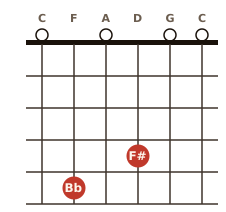
G m(maj11) stacks G – A – Bb – C – D – F#. Each chart below places those tones on the Oud's CFADGC courses at the position and finger holding each one — tap a chart to hear it.
Six courses is plenty of room to hold a Western tertian chord still, but the oud's own repertoire rarely asks for that — a taqsim treats a chord tone as a place to land between runs, not a shape to hold down and strike all at once. A maqam builds its own runs from ajnas, not chords, and this voicing is charted twice over for exactly that reason: as fingered positions you can hold, and as a set of courses a maqam-trained hand would rather pass through one at a time, jins by jins.
Positions are computed for this tuning; traditional technique may use idiomatic voicings not shown here.
On a fretless neck a position is a target, not a slot: land close and the pitch still reads as this chord, land loose and it does not. Practice each shape slowly enough to check the pitch by ear before speed arrives, and treat the marked position as a start, not a guarantee.